
Integrating AI into my Design
Process: A Journey of Transformation
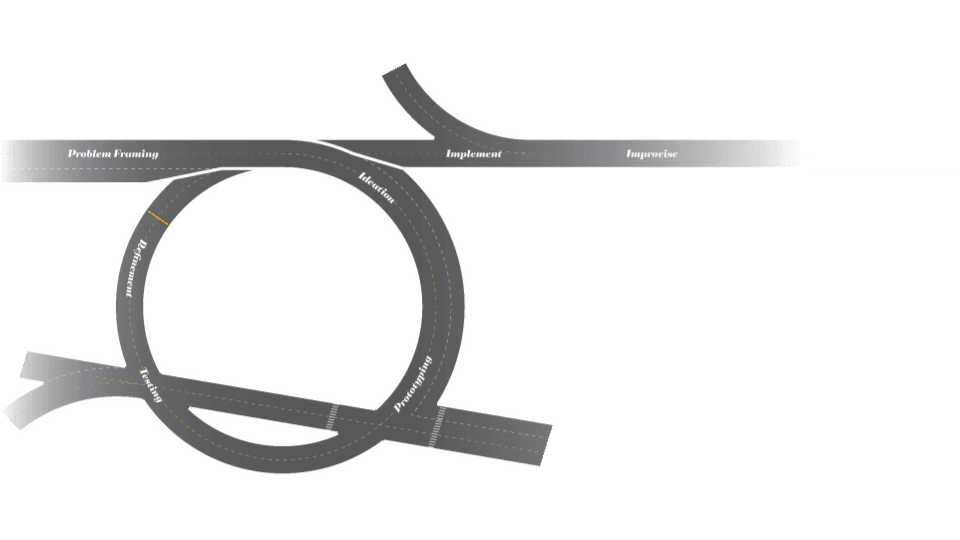
In today’s fast-evolving design landscape, leveraging AI has become increasingly vital. As a UX professional, my journey in integrating AI into my design process has led to significant changes and improvements at various stages. Below, I share how AI has been instrumental in enhancing my seven-step design process, from problem framing to continuous improvisation.
1. Problem Framing
Traditional Approach:
Traditionally, problem framing involved extensive preliminary research to understand the problem, formulating a hypothesis, and validating the need for a solution.
With AI
AI has revolutionized this step by automating data collection and analysis. Using AI-powered tools, I can quickly gather and process vast amounts of data, identify patterns, and generate insights. This accelerates the initial research phase and helps in forming a more accurate hypothesis, ensuring that the problem is well-defined and grounded in real data.
2. Ideation
Traditional Approach:
Ideation typically involves brainstorming sessions, co-designing, facilitation, and empathy-driven methodologies to generate optimal solutions.
With AI
AI aids in expanding the ideation phase by offering generative design tools that suggest numerous design alternatives based on set parameters. Machine learning algorithms can also analyze past projects and suggest innovative solutions that might not be immediately apparent. AI tools for sentiment analysis and trend forecasting further enrich the ideation process by providing insights into user preferences and emerging trends.
3. Prototyping
Traditional Approach:
The best ideas are executed into prototypes to gauge user preferences and evaluate product-market fit.
With AI
AI accelerates prototyping by providing rapid prototyping tools that create high-fidelity models in a fraction of the time. AI-driven simulations can predict user interactions, allowing for immediate adjustments. Additionally, AI can assist in creating adaptive prototypes that evolve based on real-time user feedback, ensuring a more dynamic and user-centric approach to prototyping.
4. Testing
Traditional Approach:
One optimal solution is tested with intended users through surveys and pilot testing to identify potential issues and validate the design.
With AI
AI enhances testing by using predictive analytics to forecast potential user responses and behaviors. AI-powered A/B testing tools can simultaneously test multiple design variations, providing deeper insights into user preferences. Natural language processing (NLP) algorithms can analyze user feedback more efficiently, identifying subtle patterns and sentiments that might be overlooked.
5. Refinement
Traditional Approach:
Based on feedback, the solution is refined or modified, sometimes revisiting the problem framing stage to validate changes.
With AI
AI streamlines refinement by providing real-time analytics and user feedback analysis. Machine learning models can suggest improvements based on previous iterations and user data. This continuous feedback loop allows for faster and more precise adjustments, ensuring that the refined solution aligns closely with user needs and expectations.
6. Implementation
Traditional Approach:
The final solution is made accessible to users, addressing the identified problems and catering to other relevant categories.
With AI
AI supports implementation by optimizing deployment processes and ensuring seamless integration. AI-driven analytics track the solution’s performance post-launch, providing valuable data on user interaction and satisfaction. This ongoing monitoring helps in quickly addressing any issues that arise and ensures a smooth user experience.
7. Improvisation
Traditional Approach:
An ongoing process of adapting to changing user needs, often leading to different product versions over time.
With AI
AI significantly enhances improvisation by continuously analyzing user data and market trends. AI algorithms can predict future user needs and suggest proactive changes, keeping the product relevant and competitive. This continuous learning and adaptation cycle ensures that the product evolves in line with user expectations and market demands.
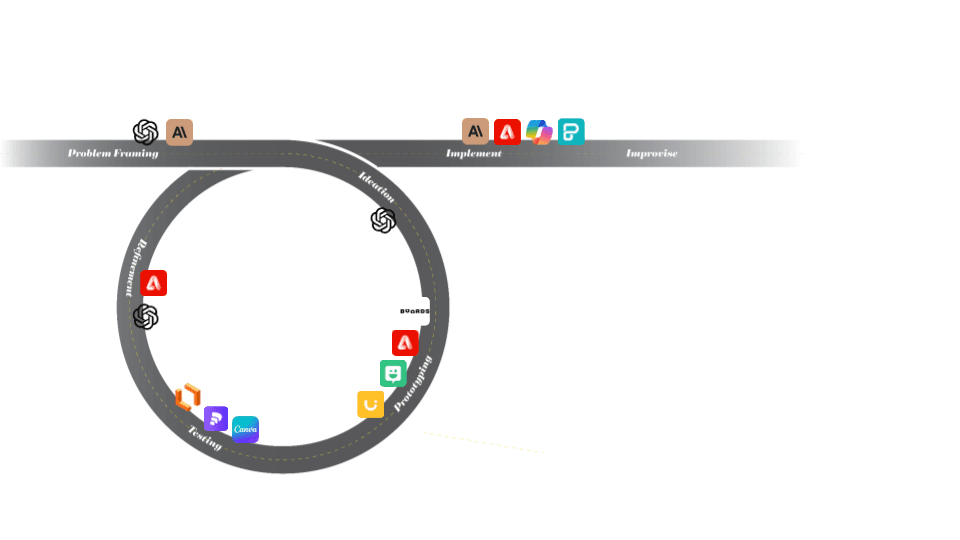
Integrating AI into my design process has transformed how I approach each stage, from problem framing to continuous improvisation. AI’s ability to analyze vast amounts of data, generate insights, and predict trends has enhanced efficiency, creativity, and user-centricity in my work. By embracing AI, I can deliver more refined, innovative, and impactful designs that resonate with users and drive meaningful change. As AI continues to evolve, its role in design will only grow, paving the way for more advanced and user-focused solutions.
Thanks for viewing.
Hope you enjoyed it!